
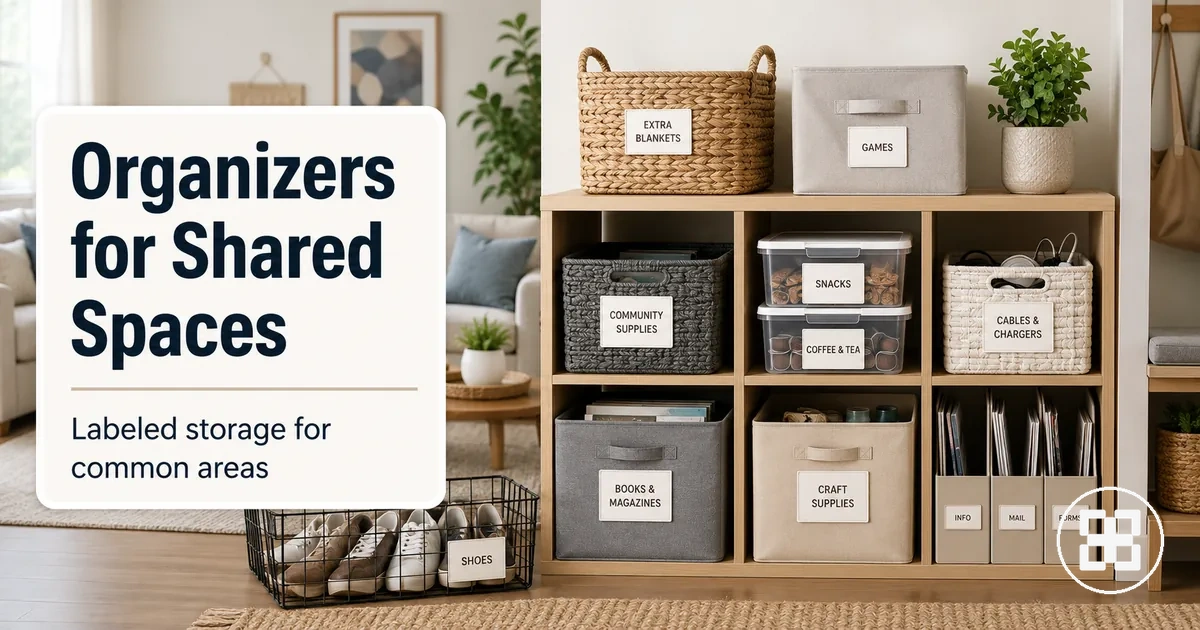
Home Organization Products for Shared Living Spaces
Home organization products for shared living spaces are storage tools designed to help multiple people use the same storage system while keeping personal and communal belongings clearly separated. They establish storage boundaries, improve visibility and access, and support consistent return points for shared items. Shared spaces include bathrooms, kitchens, closets, family rooms, and other areas where more than one person stores or retrieves everyday items. Clear ownership and storage boundaries help reduce shared-use friction.
Clear ownership and storage boundaries help reduce shared-use friction.
Shared living spaces work best when storage reflects how the space is used rather than where products fit. Labels identify personal and communal items, clear bins improve visibility when contents should be seen at a glance, and designated return points support a daily reset routine. Capacity should match the volume assigned to each user or shared category, while material should suit the room's conditions, such as moisture in bathrooms or frequent cleaning in kitchens. These criteria define practical boundaries before individual storage products are considered.
These criteria define practical boundaries before individual storage products are considered.
Choosing home organization products should begin with usage conditions instead of product type. Storage that is accessed many times each day benefits from easy visibility and quick access, while less frequently used items can be placed in less prominent locations if ownership remains clear. For example, a shared kitchen pantry may use labeled clear bins for communal snacks, while each household member keeps personal food in separate labeled containers. A bathroom shared by multiple people may instead benefit from washable organizers that tolerate regular cleaning and moisture.
Choosing home organization products should begin with usage conditions instead of product type.
As the article progresses, each product category is evaluated against ownership clarity, access, visibility, capacity, material, and daily reset habits so recommendations remain tied to real shared-space conditions rather than product lists alone.
Table of Contents
Shared Living Space Storage Needs
Shared living space storage needs are the practical requirements created when multiple people use the same room, shelf, cabinet, or closet. They focus on maintaining reliable access to shared items while preserving ownership clarity for personal belongings. Without clear storage boundaries, retrieval becomes slower, duplicate purchases become more likely, and shared-use confusion increases.
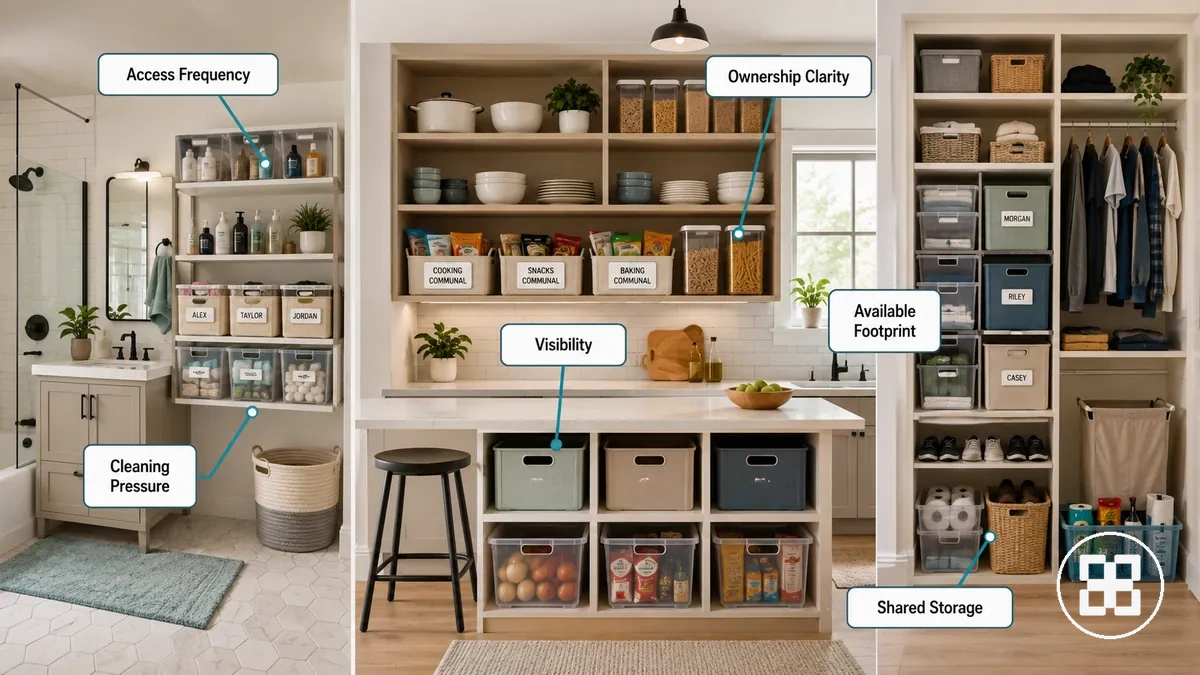
A family bathroom, shared kitchen, or roommate storage area creates different storage conditions because access frequency, available footprint, visibility, and cleaning pressure are not the same in every shared room. As explained in the home organization products hub, home organization products should be selected according to how the space is used rather than the room name alone. This section focuses on shared living space storage needs rather than general room organization, so product choice remains tied to actual shared-use conditions.
Each need defines a storage boundary before selecting organizers for a shared room.
The following points summarize the shared living space storage needs that guide storage decisions. Each need defines a storage boundary before selecting organizers for a shared room.
- Access frequency: Choose organizers that keep frequently used items within easy reach, improving retrieval for everyone using the shared space.
- Ownership clarity: Use labels or separated compartments to distinguish personal belongings from communal items, reducing accidental duplication and shared-use confusion.
- Available footprint: Select storage that fits the available cabinet, shelf, or closet space so circulation and everyday access remain unobstructed.
- Visibility: Clear bins or open-front organizers make shared contents easier to identify, reducing unnecessary searching.
- Cleaning pressure: In a family bathroom or shared kitchen, washable and moisture-tolerant organizer materials simplify repeated cleaning and support hygienic shared storage.
Personal, Shared, and Overflow Storage Boundaries
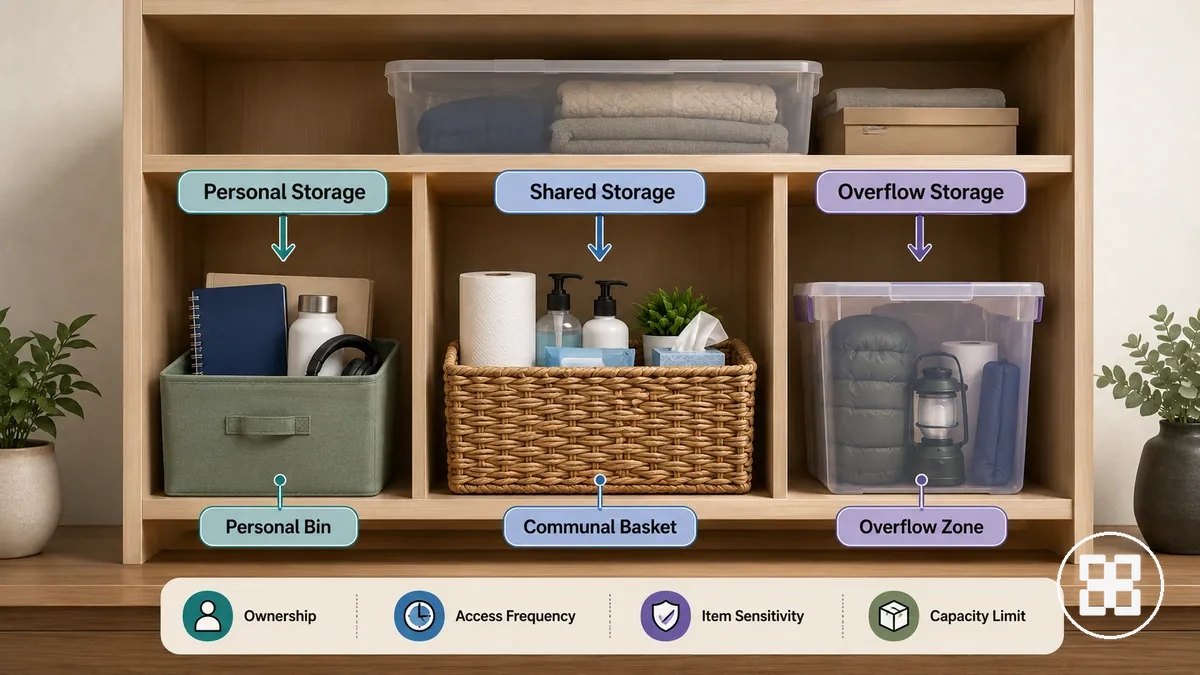
Storage boundaries classify each item by its ownership status, access frequency, sensitivity, and overflow risk before an organizer is selected. The three practical categories are personal storage, shared storage, and overflow storage. Using the correct boundary helps match each item group with the appropriate organizer.
Using the correct boundary helps match each item group with the appropriate organizer.
Personal storage is intended for personal items or sensitive items that belong to one person. A personal bin is the preferred organizer when ownership status is individual and retrieval is limited to a single user. For example, prescription medication, personal grooming products, or individual documents are easier to manage when stored in a labeled personal bin. This category preserves ownership clarity.
Personal storage is intended for personal items or sensitive items that belong to one person.
Shared storage is designed for communal items that everyone uses regularly, while overflow storage holds backup supplies or items that exceed the capacity of everyday organizers. A communal basket or shared container is suitable for frequently accessed common supplies, whereas an overflow zone separates surplus items until they are needed. For example, a shared container can hold the cleaning products currently in use, while extra paper towels remain in an overflow container on a higher shared shelf. Shared-space organization classifies storage categories only and does not replace general room-by-room storage planning.
The comparison below highlights the decision criteria for each boundary.
Personal, Shared, and Overflow Storage Boundaries become easier to apply when the storage categories are compared before choosing organizers. The comparison below highlights the decision criteria for each boundary.
| Storage boundary | Best for | Organizer signal |
|---|---|---|
| Personal storage | Personal items and sensitive items with individual ownership status | Personal bin |
| Shared storage | Common supplies with frequent shared access | Communal basket or shared container |
| Overflow storage | Backup storage and surplus items beyond everyday organizer capacity | Overflow zone |
Labels, Clear Bins, and Compartment Systems
Labels, clear bins, and compartment systems improve shared storage by making items easier to identify, retrieve, and return to the correct place. Labels support ownership clarity, transparent storage improves visibility, and compartment systems maintain separation for small categories. Together, these three feature groups reduce mix-ups without creating an unnecessarily complex storage system.
Together, these three feature groups reduce mix-ups without creating an unnecessarily complex storage system.
Label durability should match the storage environment so labels remain readable with regular handling, while clear bins allow shared essentials to be identified without opening every container. Compartment systems separate small items into stable categories, making retrieval quicker and helping maintain category memory over time. For example, a labeled clear bin for charging cables lets users recognize both the contents and the correct return location immediately. Labels, Clear Bins, and Compartment Systems can be compared using the table below to match each feature with the most appropriate shared-use condition.
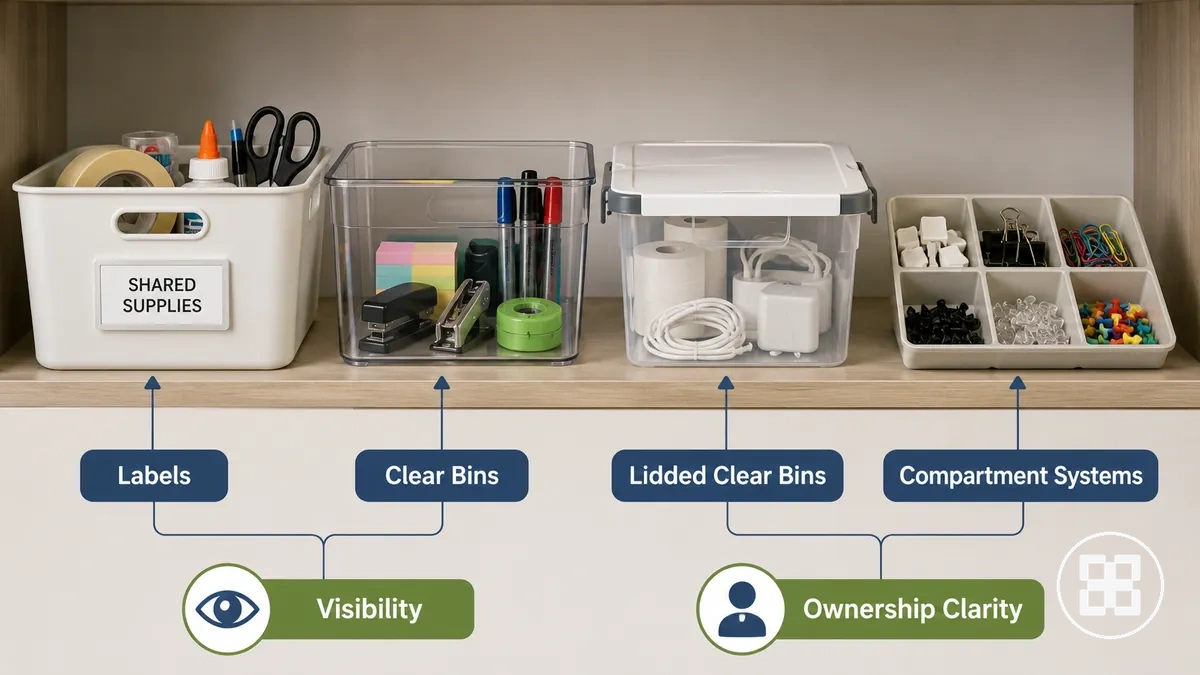
Labels, Clear Bins, and Compartment Systems work best when each feature matches its intended use rather than when every item receives its own organizer. Lidded clear bins combine visibility with protection for backup or less frequently used supplies, while refill cues help indicate when shared consumables should be replenished. For a broader comparison of enclosure styles, see open and closed storage tradeoffs, but avoid over-systemizing when simple identification already supports consistent retrieval.
| Feature | Attribute to check | Best shared-use condition | Risk if mismatched |
|---|---|---|---|
| Labels | Label durability | Shared items requiring ownership clarity and refill cues | Items are returned inconsistently |
| Clear bins | Visibility | Frequently retrieved shared essentials | Retrieval takes longer |
| Lidded clear bins | Visibility with protected contents | Backup or less frequently used supplies | Contents are harder to inspect when stored in opaque containers |
| Compartment systems | Separation | Small items that benefit from category memory | Small items become mixed together |
Labeled Bins for Ownership and Refill Cues
Labeled bins support shared use by making ownership and refill cues easy to recognize during everyday storage. Owner, category, or supply labels help people return items to the correct bin and identify when shared supplies need restocking. This approach works best when the bin contents remain stable instead of changing frequently, improving ownership recognition and refill awareness.
Labeled bins support shared use by making ownership and refill cues easy to recognize during everyday storage.
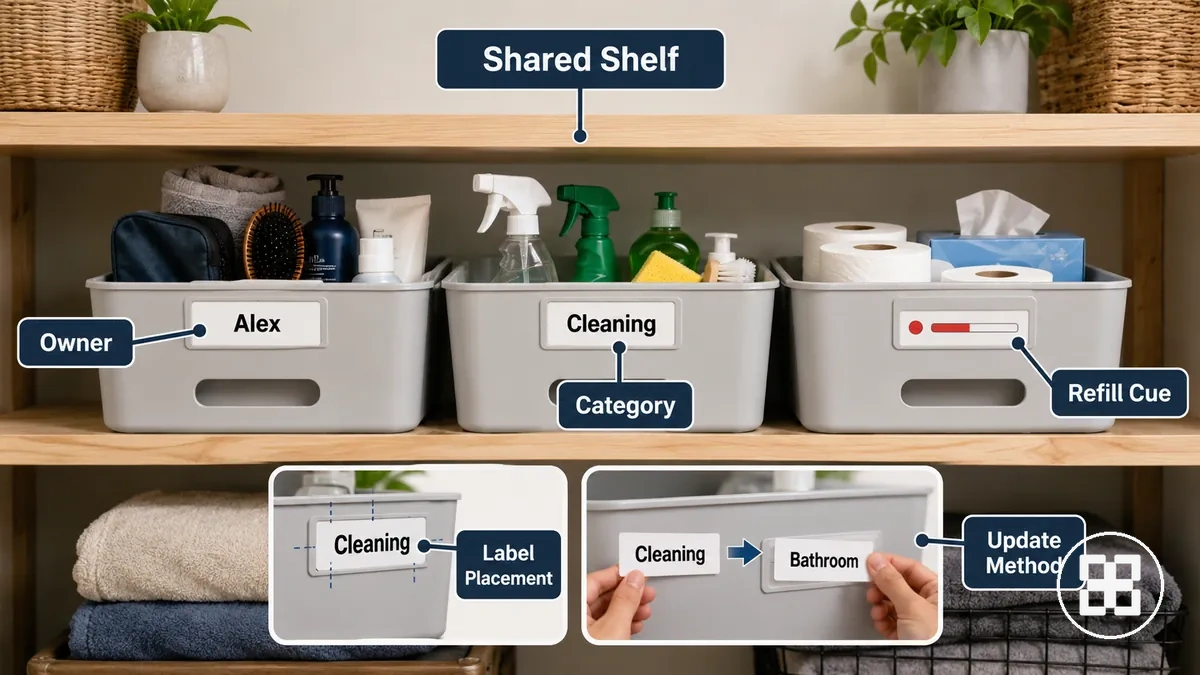
Labeled Bins for Ownership and Refill Cues are most effective when label placement keeps the information visible during normal retrieval. The image below demonstrates how owner labels, category labels, visible contents, and refill cues work together on a shared shelf.
Use the following checklist to keep labeled bins effective during repeated shared use:
- Use short owner or category labels that are easy to read.
- Place labels on the front or upper edge of the bin where they remain visible during retrieval.
- Choose an update method that allows labels to be replaced whenever contents change.
- Select durable storage labels that remain readable with regular handling.
- Avoid labeling bins with frequently changing contents unless the labels are updated at the same time.
For example, a shared shelf can include one labeled bin marked "Cleaning Supplies" with a simple refill cue when stock runs low, while a nearby personal bin uses a name label to indicate ownership. Labels help reduce mix-ups and support easier restocking when categories remain consistent, but they become less reliable if multiple users frequently change the contents of the same bin.
Multi-Compartment Organizers for Small Shared Items
Multi-compartment organizers separate small shared items into dedicated sections, making sorting easier when items would otherwise mix together or require repeated searching. The most effective compartment size matches both the item size and its access frequency, helping toiletries, utensils, batteries, craft items, and shared accessories remain organized with less repeated sorting.
Compartment size, adjustability, visibility, and cleanability determine how well a multi-compartment organizer supports daily use.
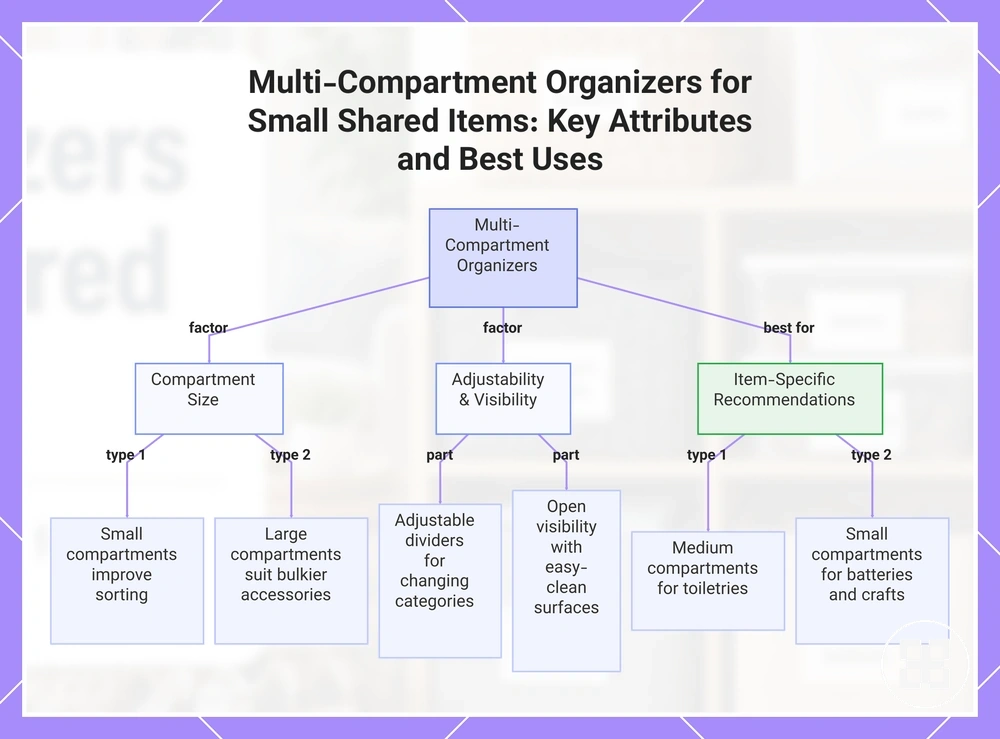
Compartment size, adjustability, visibility, and cleanability determine how well a multi-compartment organizer supports daily use. Many small compartments improve sorting for small objects, while fewer larger compartments suit bulkier shared accessories that need faster retrieval. Adjustable dividers provide flexibility when storage categories change, and open visibility with easy-to-clean surfaces helps maintain organization over time. For example, a divided organizer with adjustable sections can store batteries in small compartments while reserving a larger section for shared charging cables, but oversized compartments for tiny items can reduce sorting efficiency.
Many small compartments improve sorting for small objects, while fewer larger compartments suit bulkier shared accessories that need faster retrieval.
Choose organizer attributes based on the items being stored:
- Toiletries: Medium compartments keep frequently used items separated while remaining easy to access.
- Batteries and craft items: Small compartments improve sorting and simplify retrieval of individual items.
- Utensils and shared accessories: Larger or adjustable compartments accommodate different item sizes without unnecessary crowding.
- Changing categories: Adjustable dividers are more practical when shared items or storage groups change regularly.
This chart shows the main attributes that determine the effectiveness of multi-compartment organizers and provides item-specific recommendations for choosing compartment sizes.
Organizer Types by Shared Area
Choose organizer types according to the shared area rather than appearance or generic capacity alone, because storage constraints, item type, user access, and cleaning conditions differ by room. A bathroom organizer should suit moisture and toiletries, kitchen storage containers should suit food contact and shared pantry access, a communal closet organizer should fit the available closet depth and access height, and family room storage baskets should keep frequently used items visible enough for a quick reset. This area-based selection logic gives each organizer form a clearer shared-use outcome.
This area-based selection logic gives each organizer form a clearer shared-use outcome.
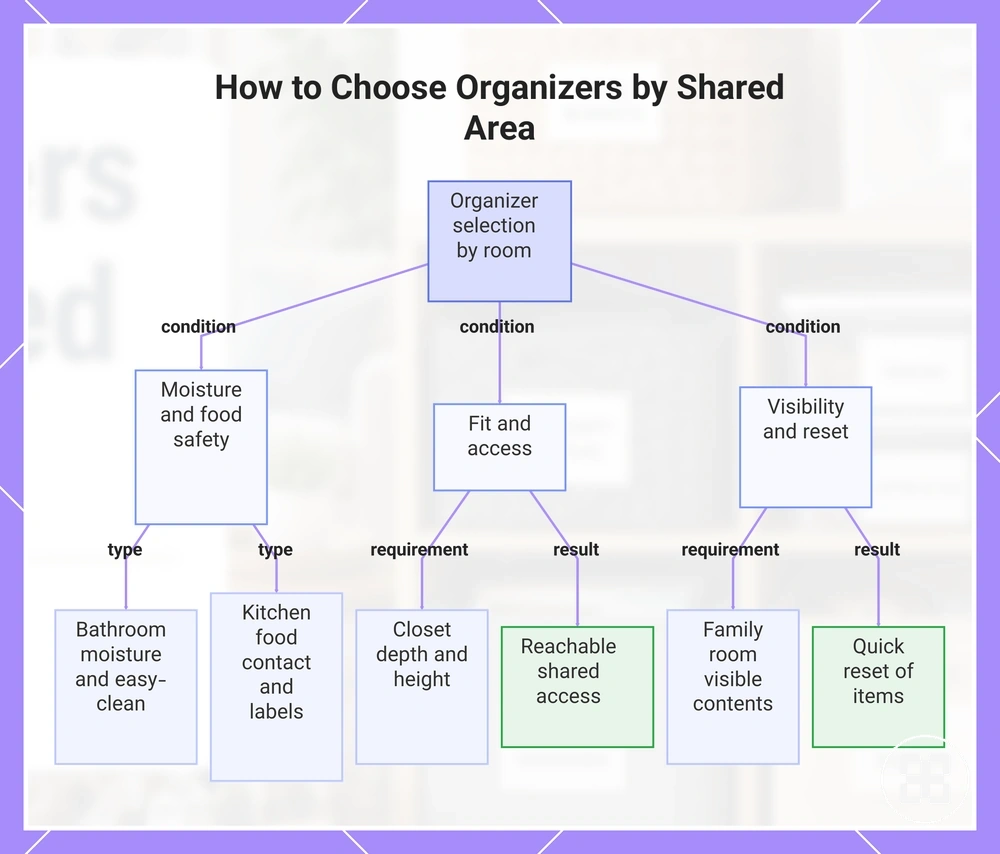
Moisture calls for a bathroom organizer with drainage or an easy-to-clean surface, while food contact calls for kitchen storage containers intended for pantry goods or shared ingredients and paired with clear labels. Closet depth and vertical fit determine whether a communal closet organizer remains reachable without blocking shared access, while visibility determines whether family room storage baskets support faster return of remotes, games, or blankets after use. The same organizer type can therefore perform differently across rooms because the cleaning condition and access pattern change. For broader room-specific planning beyond communal-use behaviour, see organizers by living space.
For broader room-specific planning beyond communal-use behaviour, see organizers by living space .
For example, an open basket may help a family room reset because its contents remain visible, but the same open form is less suitable beside a wet bathroom area when stored toiletries need drainage and easier surface cleaning.
This chart explains how to choose organizers by room, using the key conditions of moisture, food safety, fit, access, visibility, and reset needs.
This chart explains how to choose organizers by room, using the key conditions of moisture, food safety, fit, access, visibility, and reset needs.
Shared Bathroom Organizers
Shared bathroom organizers separate personal toiletries, wet items, cleaning products, and daily essentials within limited humid storage. A shared bathroom organizer works best when compartments or labels distinguish personal items from shared supplies, helping reduce unnecessary mixing during everyday use.
Moisture makes material and drainage important because water can remain on stored wet items after use.
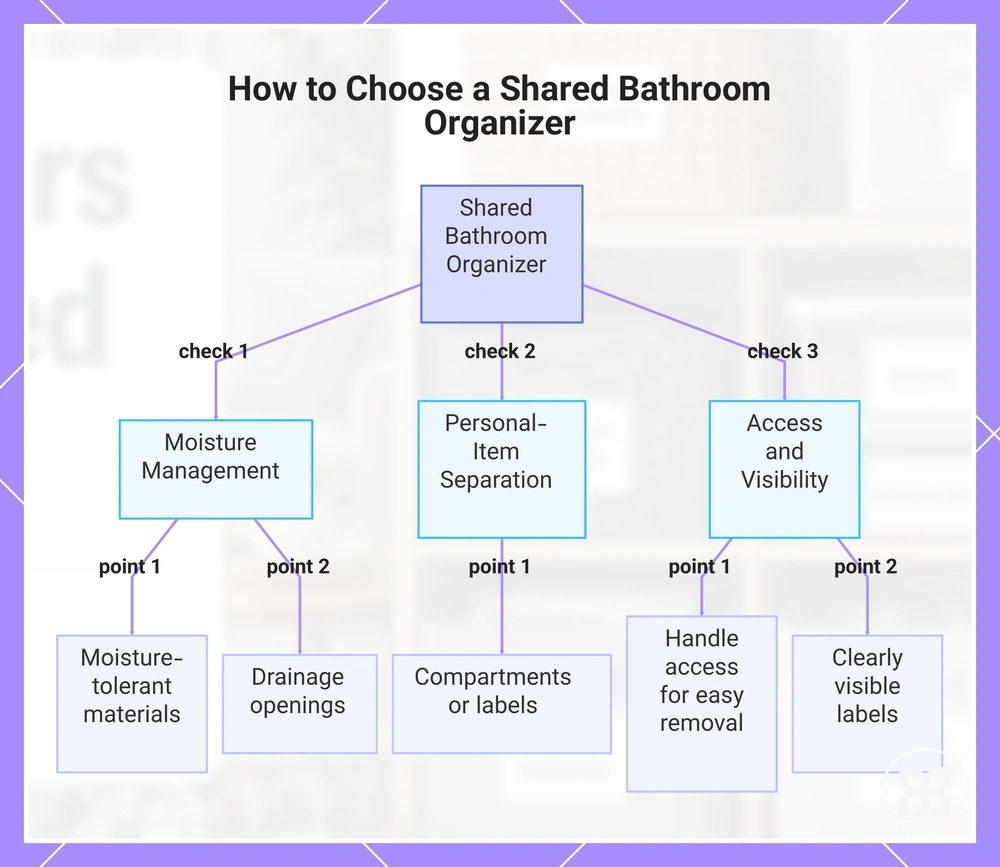
Moisture makes material and drainage important because water can remain on stored wet items after use. Plastic, coated metal, or other moisture-tolerant materials are easier to wipe clean, while drainage openings help water escape from shower accessories. Compartment size should match the stored toiletries, and handle access makes a bathroom storage caddy or under-sink bin easier to remove during the morning routine. For example, a shower caddy keeps frequently used toiletries together, while an under-sink bin separates shared cleaning products from personal items.
For example, a shower caddy keeps frequently used toiletries together, while an under-sink bin separates shared cleaning products from personal items.
Choose a shared bathroom organizer that provides:
- Moisture tolerance: A material suited to humid bathroom conditions for easier routine cleaning.
- Drainage: Openings or ventilated sections that help wet items dry between uses.
- Personal-item separation: Compartments or labels that distinguish personal toiletries from shared supplies.
- Cleaning access: Handle access that makes a bathroom storage caddy or under-sink bin easier to remove and return.
- Label visibility: Clearly visible labels so shared items can be identified more quickly during daily use.
This chart shows the three main selection criteria for a shared bathroom organizer: moisture management, personal-item separation, and access with visibility.
Shared Kitchen Storage Containers
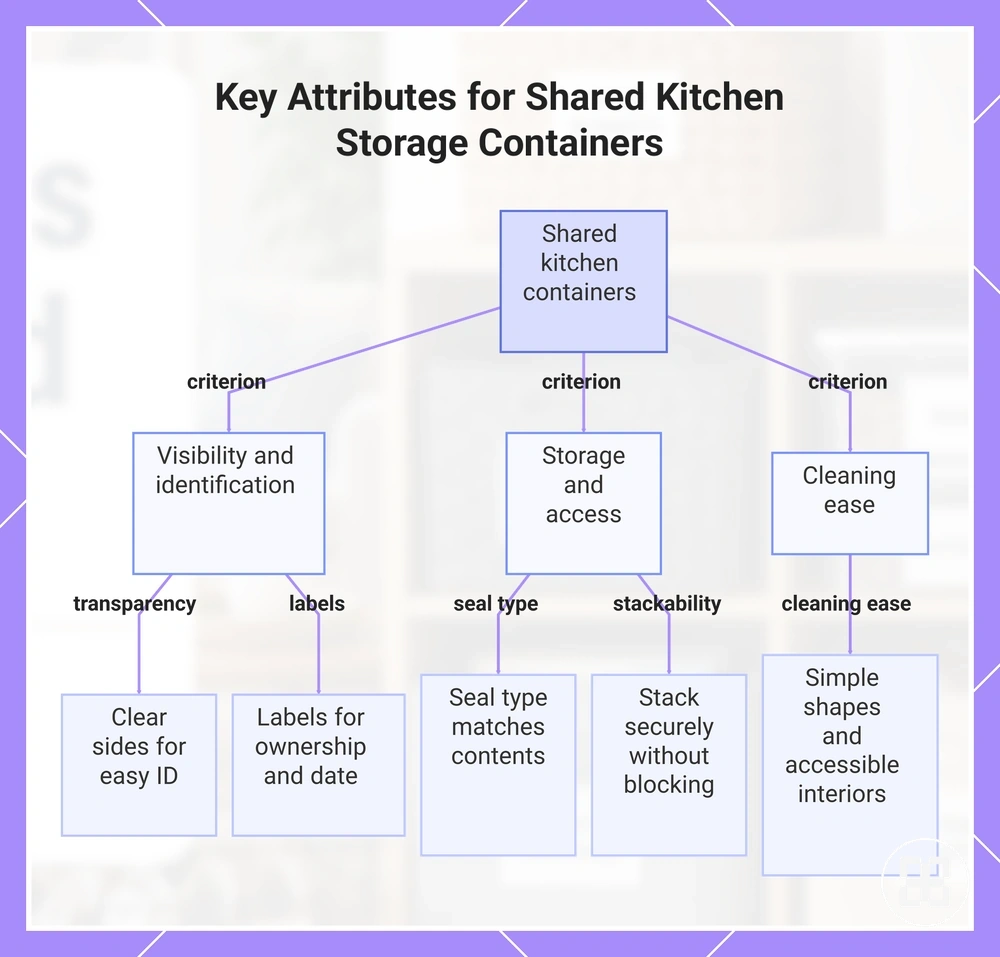
Shared kitchen storage containers organize pantry goods, leftovers, prep items, and communal supplies so household members can identify and access them without confusion. Labels that distinguish personal food from communal supplies provide clearer ownership and can support freshness tracking when dates are updated consistently.
Seal type should match the stored contents, while transparency lets users identify food without opening the container.
Seal type should match the stored contents, while transparency lets users identify food without opening the container. Container size should fit the available shelf space and the usual quantity stored, and stackability should preserve stable access rather than create hard-to-reach piles. A visible label method can identify ownership, contents, or storage date, which may reduce duplicate purchases and make shared access clearer. For example, a clear pantry container can hold communal dry goods, while a separately labelled food storage container can identify personal leftovers.
A visible label method can identify ownership, contents, or storage date, which may reduce duplicate purchases and make shared access clearer.
Choose shared kitchen storage containers that support visibility, shared access, and routine cleaning:
- Transparency: Clear sides make pantry goods and leftovers easier to identify before opening.
- Labels: Use a visible label method for ownership, contents, or storage date.
- Seal type: Match the closure to the contents, such as a fitted lid for leftovers or a secure lid for dry pantry goods.
- Stackability: Select containers that stack securely without blocking frequently used items.
- Cleaning ease: Prefer simple shapes and accessible interiors that are easier to clean between uses.
This chart shows the main criteria for selecting shared kitchen storage containers, including visibility, storage features, and cleaning ease.
Communal Closet Organizers
Communal closet organizers divide coats, shoes, linens, cleaning supplies, and seasonal items into clearly defined shared storage areas that are easier to identify and access. Shelves, closet bins, hanging organizers, and cubbies each create an ownership zone, helping reduce personal overflow while maintaining the shared closet boundary.
Shelves, closet bins, hanging organizers, and cubbies each create an ownership zone, helping reduce personal overflow while maintaining the shared closet boundary.
Vertical fit should match the available closet height so storage space remains usable from top to bottom, while access height should keep frequently used items within comfortable reach. Weight tolerance is a factor to check before placing heavier linens or cleaning supplies on shelves or hanging organizers, and visibility improves when open cubbies or labeled closet bins keep shared items easy to identify. For example, a hanging organizer can hold shared coats, while labeled closet bins separate seasonal items from everyday shoes, making retrieval easier when the closet is not overcrowded.
Vertical fit should match the available closet height so storage space remains usable from top to bottom, while access height should keep frequently used items within comfortable reach.
Choose the organizer style according to the shared storage task:
| Organizer form | Best shared use | Main risk |
|---|---|---|
| Hanging organizer | Shared coats and frequently used outerwear | Personal items can reduce shared access if space is not assigned. |
| Closet bins | Linens, cleaning supplies, and seasonal items | Contents become harder to identify without clear labels. |
| Cubbies | Shoes and individually assigned storage zones | Limited capacity can increase crowding if ownership zones are exceeded. |
| Shelf organizer | Folded shared linens and regularly used supplies | Overloaded shelves can reduce visibility and make retrieval less convenient. |
Family Room Storage Baskets
Family room storage baskets suit visible shared items such as throws, toys, games, remotes, and daily clutter that need a consistent place between uses. They support a quick shared-area reset by keeping frequently used items together and reducing the chance that everyday objects remain scattered across the room.
Material should withstand regular handling, while openness keeps visible shared items easy to identify during daily use.
Material should withstand regular handling, while openness keeps visible shared items easy to identify during daily use. Basket capacity should match the usual amount of shared items without encouraging overflow, and handle access makes baskets easier to move for cleaning or shared activities. Placement beside seating areas or where daily clutter commonly gathers can support faster reset, lower visual clutter, and safer shared access when everyone returns items after use. For example, an open basket beside the sofa keeps throws and remotes visible, while a closed container is better suited to items that do not require immediate access.
For example, an open basket beside the sofa keeps throws and remotes visible, while a closed container is better suited to items that do not require immediate access.
Choose family room storage baskets according to their shared-use role:
- Material: Durable woven, fabric, or plastic baskets are suitable for repeated everyday handling.
- Openness: Open baskets make throws, games, and remotes easier to see and return after use.
- Capacity: Select a basket large enough for the usual daily clutter but small enough to discourage overflow.
- Handle access: Built-in handles make storage baskets easier to carry between shared spaces.
- Placement: Position baskets near where visible shared items are typically used so the family room can be reset more efficiently.
Fit, Capacity, and Material Criteria for Shared Use
A shared-space organizer remains practical when its fit, capacity, and material criteria match the room dimensions, stored-item volume, and frequency of shared use. Size, closure, transparency, handle quality, and cleaning condition also influence access and maintenance. These criteria should be evaluated together before making a selection decision.
These criteria should be evaluated together before making a selection decision.
Fit requires the organizer's dimensions to remain within the intended shelf, floor, or cabinet space while leaving enough clearance for opening, lifting, or removal. Capacity should hold the normal shared-item volume without compressing contents or obstructing handles and closures. A larger organizer is more appropriate when the item load is consistently high and the placement area can support its footprint, while a smaller open organizer suits lighter loads that need frequent access.
Material choice should reflect repeated handling and the expected cleaning condition.
Material choice should reflect repeated handling and the expected cleaning condition. A stronger rigid material is more appropriate when the organizer will be moved frequently or hold dense items, while a washable fabric or plastic surface suits areas exposed to spills, dust, or repeated contact. Cleanability should match the stated care method, such as wipe-clean, hand-washable, or machine-washable, because using an unsupported method can damage the organizer.
Each row connects an attribute to its shared-use condition and likely access outcome.
The following table applies Fit, Capacity, and Material Criteria for Shared Use to the main organizer factors. Each row connects an attribute to its shared-use condition and likely access outcome.
| Organizer factor | Attribute to check | Shared-use condition | Effect or decision |
|---|---|---|---|
| Fit | External dimensions and opening clearance | The organizer must fit its location and remain removable without blocking adjacent storage or walkways. | Reject sizes that create fit risk or restrict normal access. |
| Capacity | Usable internal volume | The normal item load should fit without overfilling or covering the opening. | Choose greater capacity for stable high-volume storage and lower capacity for frequently reset items. |
| Material | Rigid, flexible, moisture-resistant, or washable construction | Repeated access, item weight, and exposure to dust or spills determine the required material category. | Select stronger rigid construction for frequent movement and washable material where routine cleaning is expected. |
| Closure | Open, lidded, zipped, or latched access | Open access supports frequent retrieval, while enclosed storage limits dust exposure and contains loose items. | Use an open organizer for high-frequency items and a lidded organizer for lower-frequency or containment-sensitive storage. |
| Transparency | Clear, partially visible, or opaque sides | Users need either immediate content recognition or visual concealment. | Choose transparent storage for faster identification and opaque storage when concealment is the priority. |
| Handle quality | Integrated grip, reinforced handle, or no handle | The organizer is lifted or repositioned during regular shared use. | Prefer reinforced or integrated handles when movement is frequent; stationary organizers may not require handles. |
| Cleaning condition | Wipe-clean, hand-washable, or machine-washable care method | The organizer is exposed to spills, dust, moisture, or repeated hand contact. | Select a care method that matches the hygiene burden and follow the stated cleaning condition. |
A stronger organizer is more appropriate when repeated lifting or dense contents create higher handling stress, while a washable option suits locations with routine spills or contact. Choose a lidded organizer when containment or dust control matters, a transparent organizer when rapid identification matters, and an open organizer when frequent shared access takes priority. The final selection decision should balance fit risk, storage capacity, hygiene burden, and access outcome for the actual placement and users.
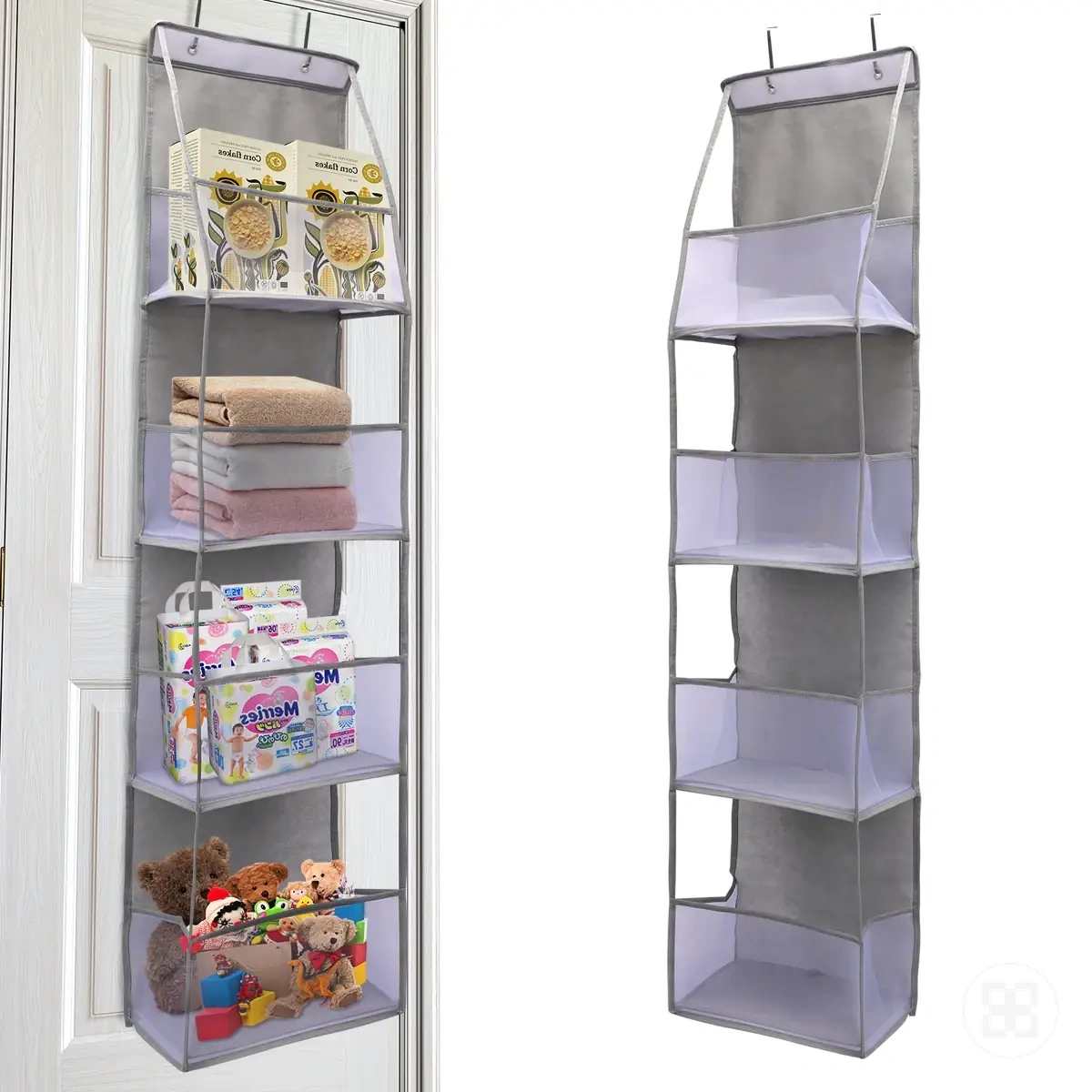
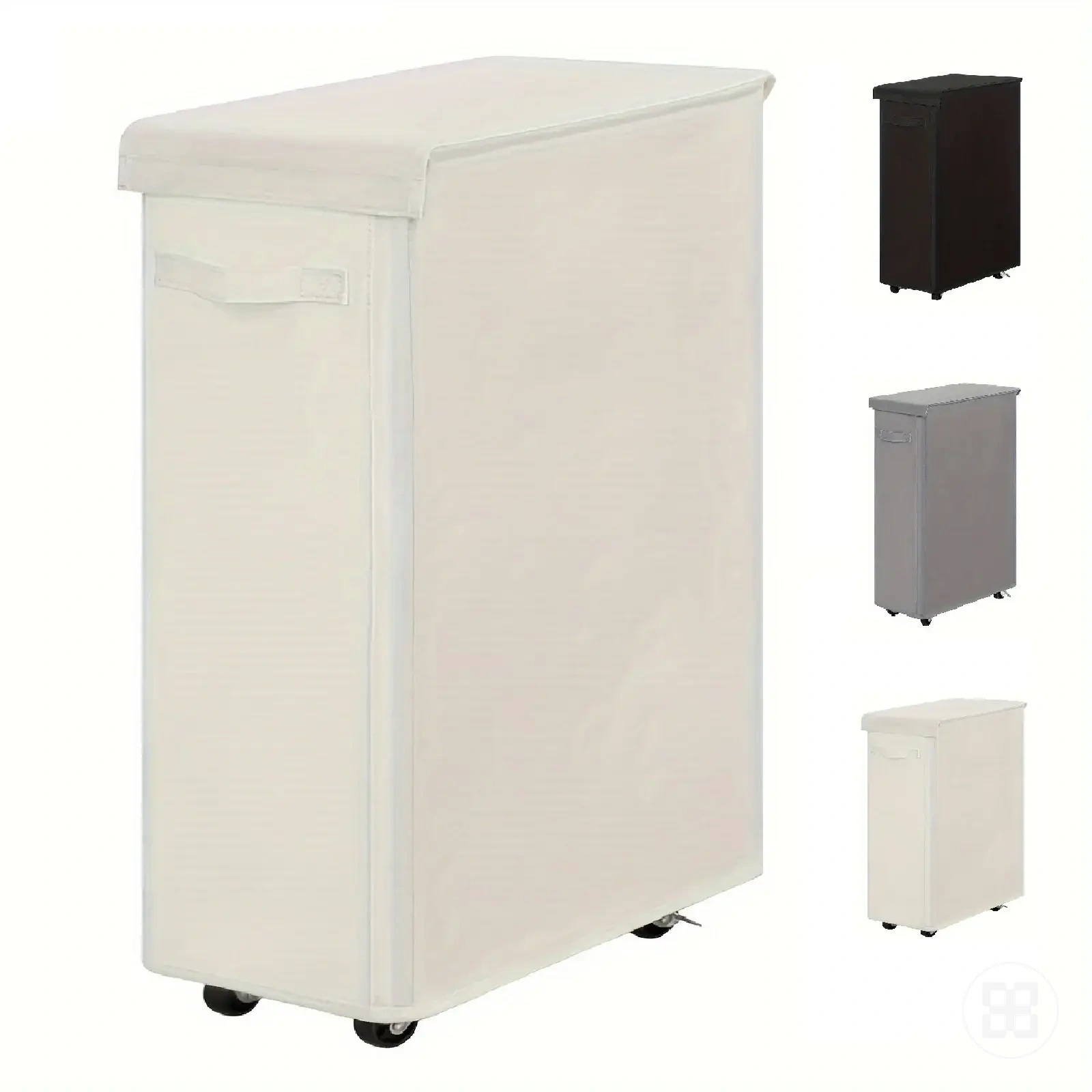
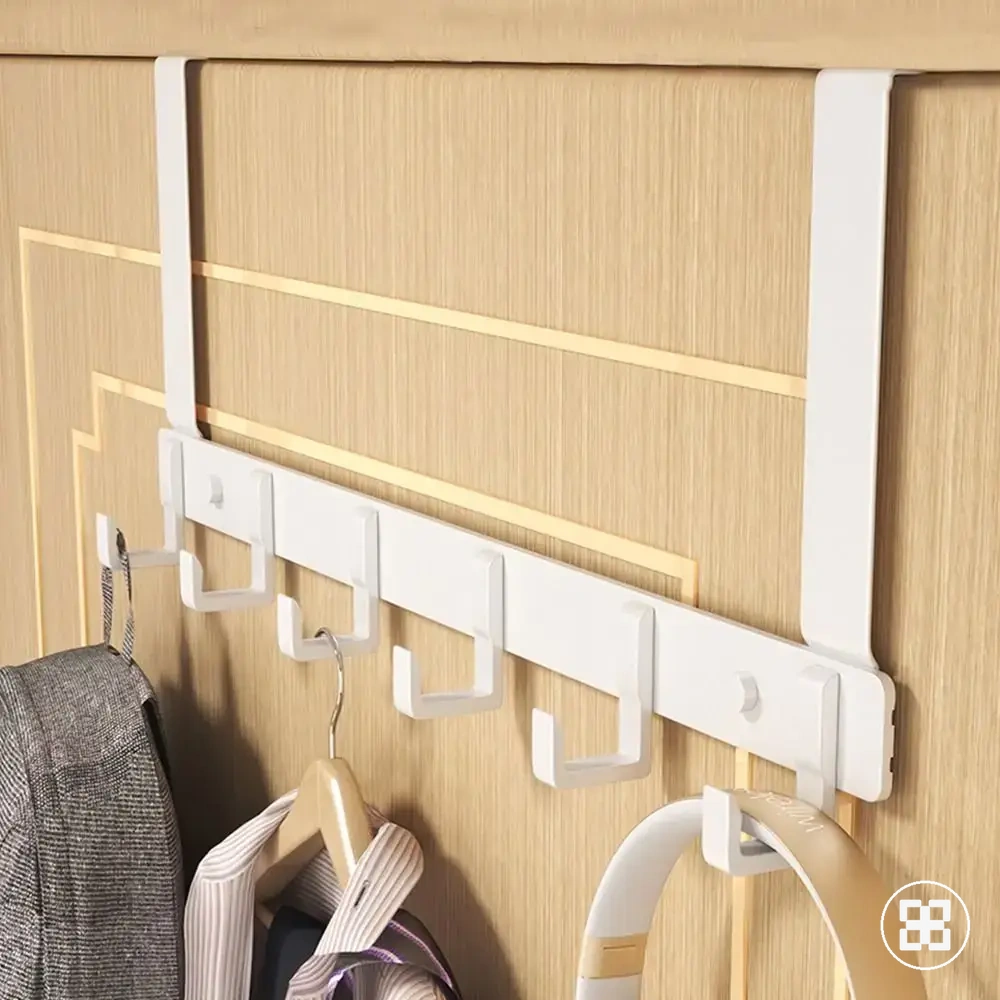
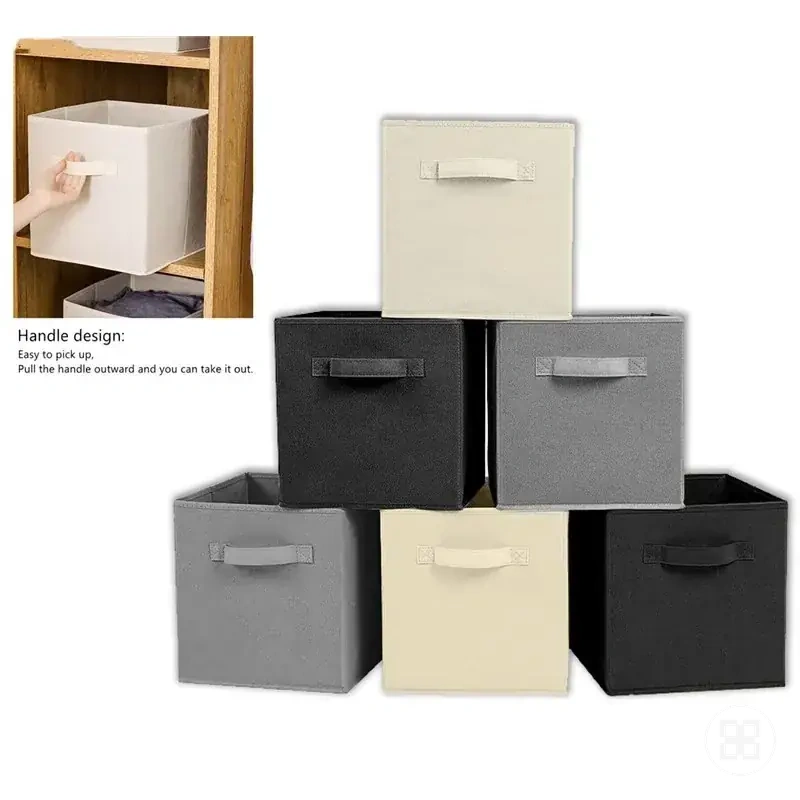
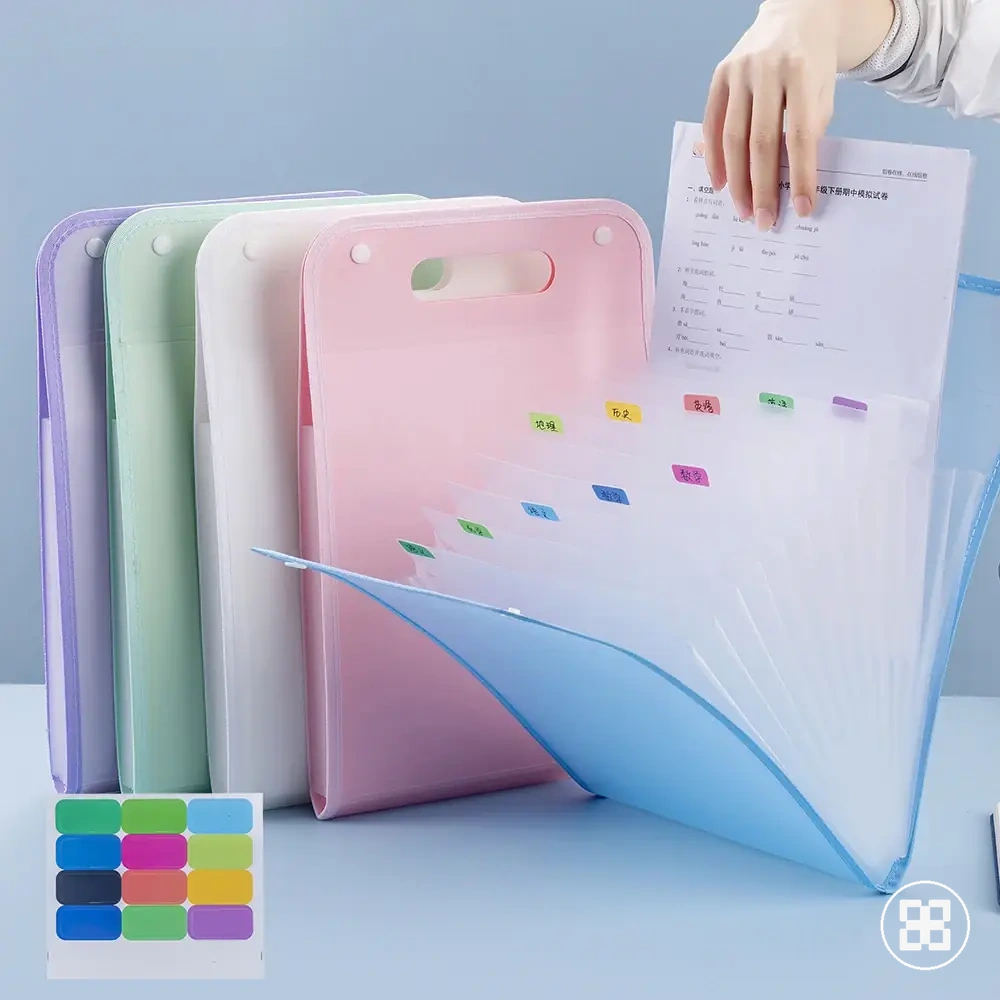
Here are product examples that may make comparison easier.
Here are product examples that may make comparison easier. Before buying, always review the compatibility criteria, essential features, and product details.
Size and Capacity Ranges
Organizer size and capacity ranges should match the available storage zone, the usual item volume, and how multiple people access the space. An organizer is too large when it obstructs removal or shared movement, and too small when normal contents create overfilling risk. Compare the organizer size with the actual shelf, cabinet, drawer, floor area, or closet zone.
Compare the organizer size with the actual shelf, cabinet, drawer, floor area, or closet zone.
Width and depth should remain within the storage zone so the organizer does not project into walkways or block adjacent items. Height should fit beneath a shelf, inside a drawer, or within a cabinet while leaving enough clearance for lids, handles, stacking, and removal. Capacity is usable when the normal item load fits without compression or overflow, while user reach should allow intended users to retrieve the organizer without difficult stretching or an unstable stacking limit. For example, a deep container placed above comfortable reach can reduce access even when its width and height fit the closet zone.
- Width: Keep the organizer within the available horizontal space so it does not block neighbouring storage or shared movement.
- Depth: Choose a depth that keeps contents reachable and prevents the organizer from extending beyond the shelf or cabinet edge.
- Height: Allow vertical clearance for opening, lifting, or stacking without contact with the shelf or drawer above.
- Clearance: Leave working space around lids, handles, doors, and drawer fronts so daily access remains practical.
- Capacity: Match usable capacity to the normal item volume; repeated compression or overflow indicates that the storage volume is too low.
- User reach: Place frequently used organizers within a comfortable access zone and limit stacking where upper containers become difficult to retrieve.
Plastic, Glass, Fabric, Wicker, and Metal Choices
Material choice changes shared-use performance because cleanability, transparency, weight, ventilation, softness, and moisture behavior differ between plastic, glass, fabric, wicker, and metal. A suitable material should match the conditions in bathrooms, kitchens, closets, or living rooms rather than serving as a universal choice. The right balance comes from comparing these material-dependent trade-offs.
The right balance comes from comparing these material-dependent trade-offs.
The table below compares common material types by their shared-space strengths and maintenance burden. Room conditions, expected moisture exposure, and handling frequency determine which material is the more practical option for a particular storage area. For example, a washable material suits damp locations, while breathable storage is often more appropriate for dry textiles.
| Material | Useful attribute | Shared-space trade-off | Better condition |
|---|---|---|---|
| Plastic | Good cleanability and moisture tolerance | Usually wipes clean easily but provides limited ventilation. | Bathrooms, kitchens, or areas exposed to moisture and frequent cleaning. |
| Glass | High transparency | Makes contents easy to identify but is typically heavier and requires careful handling. | Kitchens or display storage where visibility is more valuable than portability. |
| Fabric | Softness and ventilation | Protects delicate items and allows airflow but generally requires more maintenance than wipe-clean materials. | Closet storage for clothing, bedding, or other soft household items. |
| Wicker | Breathable storage and natural appearance | Supports ventilation but woven surfaces can increase the cleaning burden by collecting dust. | Living rooms or family spaces where appearance and airflow matter more than moisture resistance. |
| Metal | Rigid structure | Commonly supports heavier shared-use loads but usually weighs more than plastic or fabric organizers. | Shared storage areas that regularly hold dense or heavy household items. |
Access, Visibility, and Daily Reset Habits
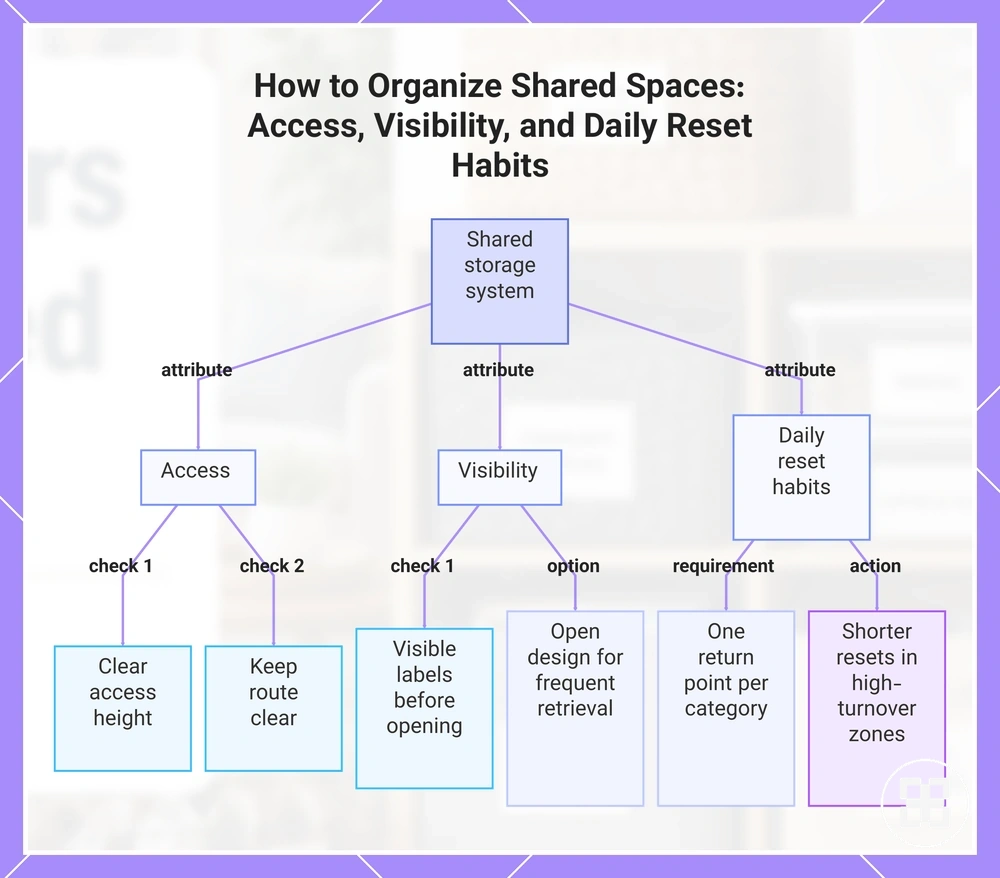
Shared-space organizers become harder to maintain when users cannot identify, retrieve, or return items quickly. A storage system should reduce these obstacles through clear return points, practical access height, and visible contents or labels. Access and visibility therefore form the main usage frame for repeated access.
Access and visibility therefore form the main usage frame for repeated access.
Place frequently used organizers at an access height that allows shared users to retrieve and replace items without moving other containers. Label visibility should support quick identification before a container is opened, and each item category should have one clear return point. An open design reduces retrieval steps when contents are used often, while a closed design provides concealment when frequent visual access is unnecessary.
Daily reset habits are easier to continue when return friction remains low.
Daily reset habits are easier to continue when return friction remains low. A simple return action, such as placing an item into a visible labelled tray, creates less friction than opening, unstacking, and rearranging multiple containers. Reset frequency should increase in high-turnover zones because shorter, more frequent resets limit clutter recurrence before misplaced items accumulate.
For broader guidance on how to use organizers without more clutter , follow the separate clutter-prevention guidance.
For example, an entryway used by multiple household members may work better with open baskets and visible labels than with fully concealed storage because keys, bags, and accessories need rapid return. For broader guidance on how to use organizers without more clutter, follow the separate clutter-prevention guidance.
For example, an entryway used by multiple household members may work better with open baskets and visible labels than with fully concealed storage because keys, bags, and accessories need rapid return.
Use this checklist to assess whether the storage system supports continued shared use:
- Access path: Keep the route to frequently used organizers clear of other containers.
- Visibility: Use visible storage where quick identification is more important than concealment.
- Label position: Place labels where users can read them before opening or removing the organizer.
- Return point: Assign one consistent location to each item category.
- Reset frequency: Use shorter, more frequent resets in high-turnover shared zones.
- Open or closed choice: Select open design for frequent retrieval and closed design where concealment has greater value.
This chart outlines the three main aspects of shared storage system design—access, visibility, and daily reset habits—and the key checks and actions for each.
Shared-Space Organizer Mistakes to Avoid
Shared-space organizer mistakes usually come from unclear ownership, poor fit, weak visibility, or hard cleaning rather than from the organizer alone. These failure patterns can increase mix-ups, clutter recurrence, and maintenance effort when multiple people use the same storage. The useful diagnostic frame is mistake, likely cause, visible symptom, and safer correction.
The useful diagnostic frame is mistake, likely cause, visible symptom, and safer correction.
Unclear ownership develops when labels are inconsistent, overlabeling makes categories difficult to scan, or no user knows who should manage a storage zone. Opaque bins used for shared essentials create a visibility problem because users must open containers before identifying the contents. A safer correction is to use short, consistent labels, visible storage for frequently accessed items, and clear ownership rules for shared and personal categories.
Opaque bins used for shared essentials create a visibility problem because users must open containers before identifying the contents.
Poor fit appears when organizer capacity is lower than the typical volume or dimensions of the stored items, producing overfilling, crowding, or unstable stacking. Hard cleaning appears when basket materials or surface textures trap dust, residue, or moisture and therefore require more effort than wipe-clean alternatives. For a broader diagnosis of related shared-space organizer mistakes, compare the cause with the visible symptom before replacing or rearranging storage.
The Shared-Space Organizer Mistakes to Avoid table below connects each failure pattern with its likely cause, visible symptom, and safer correction.
The Shared-Space Organizer Mistakes to Avoid table below connects each failure pattern with its likely cause, visible symptom, and safer correction.
| Mistake | Likely cause | Visible symptom | Safer correction |
|---|---|---|---|
| Overlabeling | Too many labels or inconsistent category names | Users ignore labels or place items in conflicting categories | Keep labels short, consistent, and limited to categories that need clarification |
| Opaque bins for shared essentials | Contents are concealed despite frequent shared access | Users open multiple bins or leave items outside after retrieval | Use transparent containers or clearly positioned front labels for frequently shared items |
| Poor fit | Organizer capacity or dimensions are smaller than the normal stored load | Overfilling, crowding, unstable stacking, or items protruding from the container | Match internal dimensions and usable capacity to the typical item quantity and shape |
| Hard-to-clean baskets | Material or woven surfaces trap dust, residue, or moisture | Cleaning is delayed because the basket requires detailed washing or drying | Choose smooth, washable materials in zones exposed to food residue, dust, or moisture |
| Unmanaged overflow zones | No ownership rules, capacity limit, or review point for excess items | Temporary piles become permanent and the original storage loses its function | Assign one defined overflow zone with clear ownership and a regular review rule |
Safer corrections improve long-term usability when they reduce identification steps, match capacity to the normal load, lower the cleaning burden, and assign ownership to overflow zones. These practical corrections can reduce clutter and mix-ups without treating one organizer type as a universal solution.
Before buying, always review the compatibility criteria, essential features, and product details.
Here are product examples that may make comparison easier. Before buying, always review the compatibility criteria, essential features, and product details.